There’s another unique quality to IDA that powers this process of discovery. As you know, there are often multiple variables that are at play in most business decisions.
Artificial intelligence is transforming the way people work by streamlining processes and handling routine tasks efficiently. When it comes to research, AI can sift through mass volumes of data and provide significant insights that can help power your business.
But.
AI only does what you tell it to do. And, sometimes you just don’t know the questions to ask until you start going through the data.
For example, medical researchers might direct AI to analyze patient records, lab results, and medical imaging data to find commonalities among patients with a rare disease. While the algorithm finds patterns, it’s often the researcher’s intuition and experience that help pinpoint the root cause.
A doctor might notice that patients all take a common medication and direct the AI to look for other patients who take this same medication to see if they show any of the markers of the disease. Based on the human-driven AI approach, a previously unknown side effect might be uncovered.
It’s a symbiotic relationship. Without AI, researchers would not be able to sort through the mass amounts of available data efficiently. With human intuition, the AI wouldn’t ask specific questions to reveal underlying causes.
It’s this cycle of discovery, directing the intelligence tools to probe more deeply, answer questions, and find hidden correlations that can be the key to solving problems.
AI is also only going to analyze the data you provide it. It will process what you give it, but relies on the data framework you build. It might not be the medication that is causing the problem, but a combination of that medication and other variables such as age, family history, or other medical conditions. These are things a doctor would review before making a diagnosis, but if you don’t ask the right questions, you won’t get the data you need.
An Iterative Process of Discovery
This process only works if you have a business intelligence tool that empowers you to go on this journey of discovery. A data scientist might be able to work through these steps, but might not have the expertise to ask the right questions. This often results in a back-and-forth between end users and IT teams. IT runs the reports. Users analyze it and ask another question. Then, it goes back to IT again. Since everyone’s busy, this back-and-forth process can take weeks or months.
But, what if the end users, the category experts, could do it all themselves with a simple-to-use, no-code, intuitive interface that lets them ask endless questions and compare multiple variables?
With IDA, users can engage directly with the data and conduct searches on the fly without having to wait for IT teams to create dashboards, visualizations, or reports. This creates a dynamic approach to finding insights and solving problems.
IDA leverages AI to sort and sift data to find insights. Experts can then look at these insights to find the next question to ask — without having to send it back to IT or learn to code.
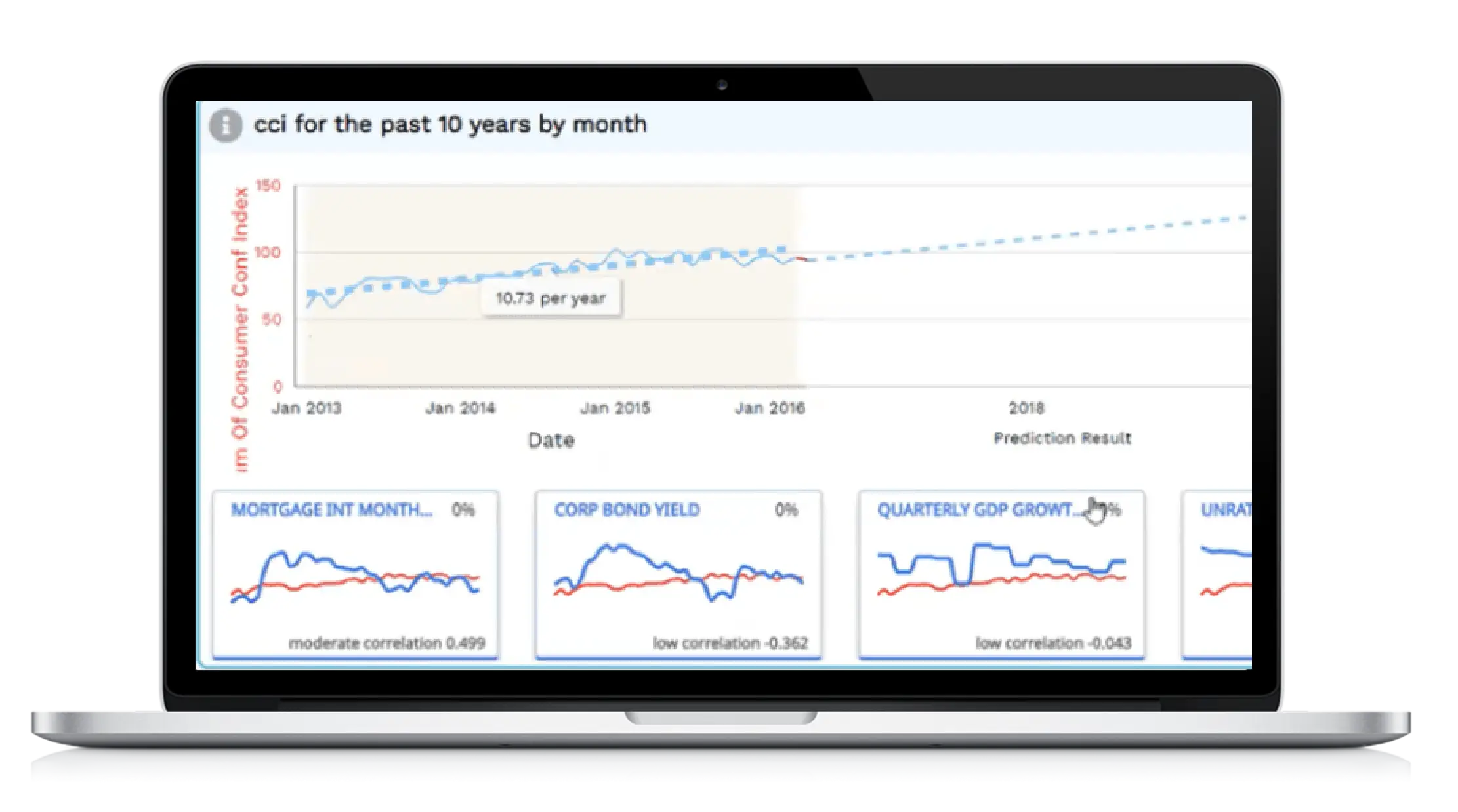
There’s another unique quality to IDA that powers this process of discovery. As you know, there are often multiple variables that are at play in most business decisions.
Let’s look at the Federal Reserve’s monitoring of interest rates and how they adjust them to control inflation. If there was a direct link between inflation rates and interest rates, the decision would be easy to use one as a lever to impact the other. However, it’s not that simple. Inflation depends on unemployment rates, GDP growth, wage growth, oil prices, exchange rates, consumer spending, supply chain disruptions, and a host of other variables.
To make it more complex, these variables can create feedback loops. The actions you take to address one area can create problems elsewhere. So, how do you find the exact right combination?
With IDA, you can look at each of these variables and how they impact the bigger picture. IDA enables you to run what-if scenarios to predict outcomes. If you lower interest rates, but unemployment continues to trend down amid stagnant wage growth, what happens? With IDA, it’s easy to see the impact and what happens when these variables change.
You can adjust each of these variables and find the best combination that produces the results you want. Then, you can dive deeper into any of the variables to uncover the underlying triggers that contribute to a change. And you can do it without coding or sending things back to your IT team.
IDA: Human-Driven AI Data Analytics
IDA empowers you with a BI tool that allows anyone to go on a journey of discovery and uncover the business insights you need to make better decisions. The power of AI and human intuition and experience are a powerful combination that simply produces better results.
Contact Intuitive Data Analytics for a free demo and see for yourself.