
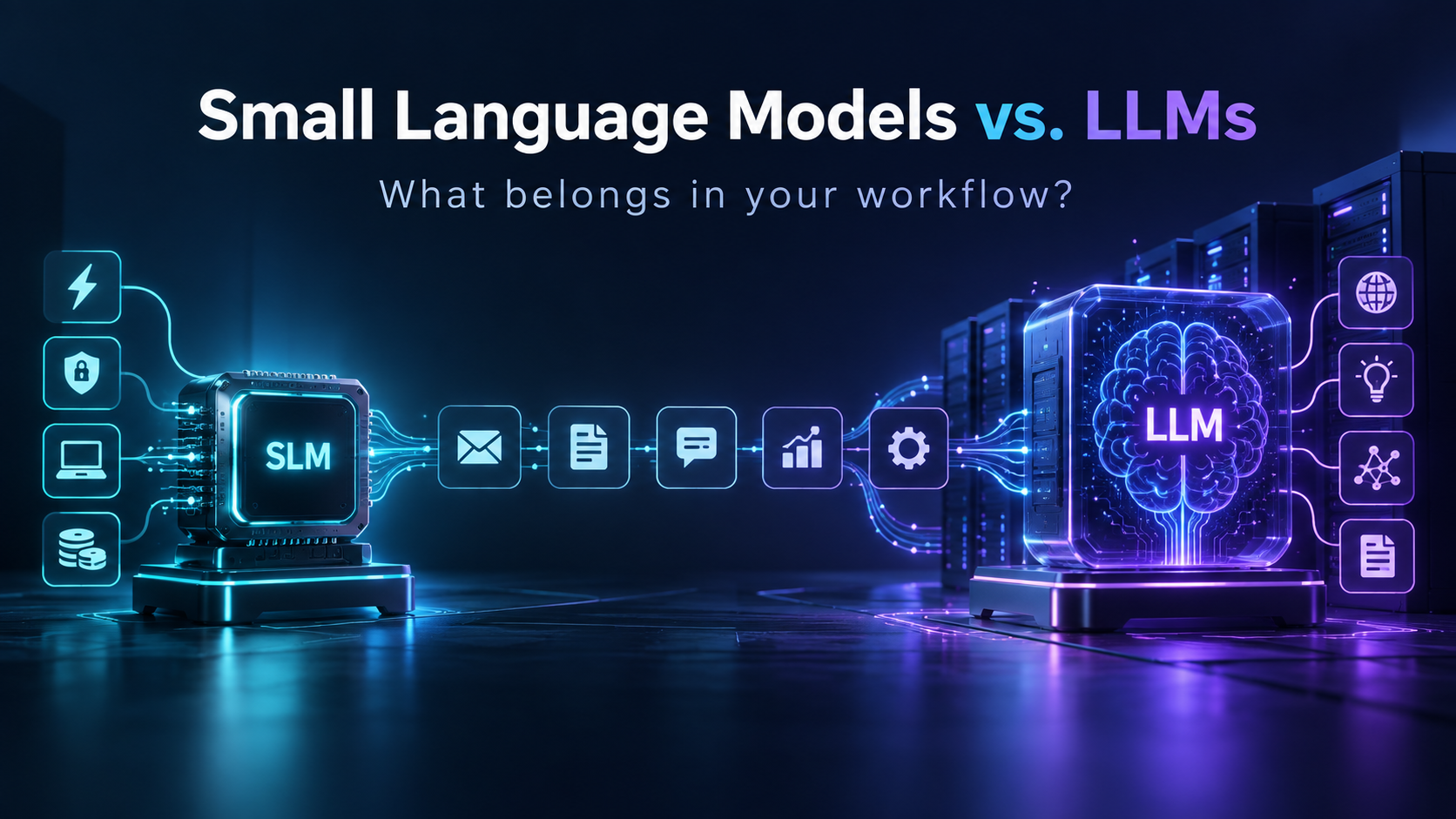
Ask a room full of engineering leads if they need a bigger model or a smaller one, and you’ll get two confident, but opposite answers in the same conversation. One camp is still routing every task to the newest frontier release. The other has quietly started sending 80 percent of its workload to models a fraction of the size. Both groups think they’re doing it right, and in 2026, the gap between them is showing up directly on the AI budget line.
Large language models are generalists. Small language models are specialists. The generalist can handle almost anything that you throw at it, but you pay a minimum for that flexibility on every single call, even if it’s the most boring and repetitive ones. The specialist does one job extremely well, costs a fraction as much to run, and doesn’t care that it can’t also write you a sonnet.
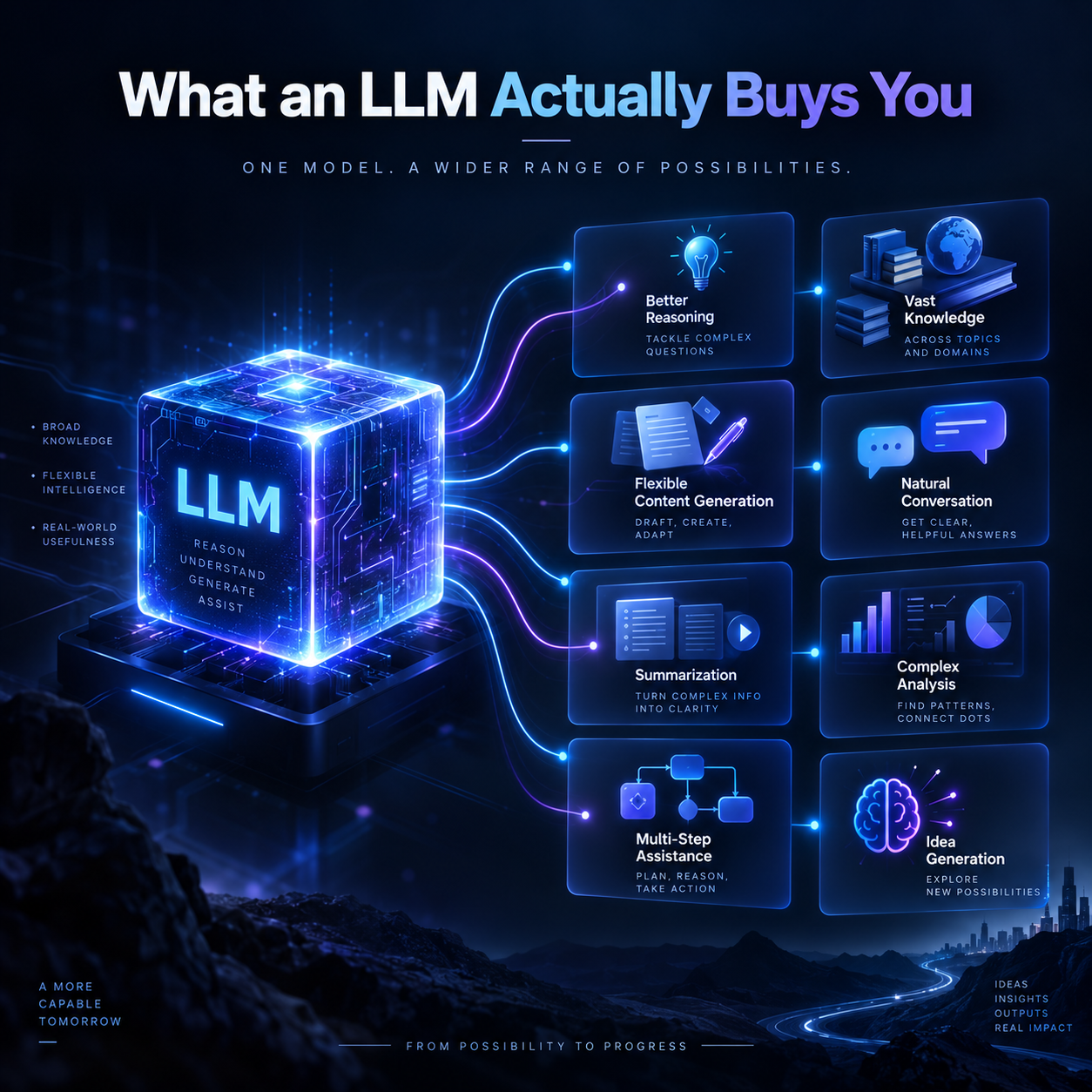
Large language models, the GPT-5s, Claude Opus-class models, and Gemini Ultras of the world, carry tens to hundreds of billions of parameters and train on vast, diverse datasets. That scale is what gives them broad contextual understanding: they can move from a legal question to a piece of code to a marketing brief in the same conversation without missing a step, as said in RapidOps’ breakdown of enterprise LLM use.
That generalism earns its keep when a task is genuinely open-ended, when the reasoning is novel, or when the model has to hold a long, messy context in its head. What it doesn’t do well is staying cheap when you point it at tasks that don’t need any of that.
A small language model runs on the same basic transformer architecture, just built lean, typically in the range of a few million to around 7 billion parameters. Most SLMs run on a single GPU, sometimes on commodity hardware, and they’re frequently fine-tuned for one narrow job instead of trained to know a little about everything.
Recognizable names in this category include Microsoft’s Phi-3 and Phi-4, smaller Llama 3 variants, Mistral 7B, and Google’s Gemma, alongside a long tail of models fine-tuned in-house by companies that would rather not send every query to a third-party API.
What SLMs give up in general knowledge, they make up for in speed, cost, and control. Between 40 and 70 percent of queries currently sent to an LLM could be handled by a small model without a meaningful drop in performance. That’s not a marginal efficiency play. That’s most of the workload.

The clearest articulation of this shift came out of NVIDIA Research, when researcher Peter Belcak and a team from the Deep Learning Efficiency Research Group published Small Language Models Are the Future of Agentic AI, arguing that SLMs are sufficiently powerful, better suited by design, and necessarily cheaper for most of the calls an agent makes.
Their analogy isn’t that large models are outdated; it’s the fact that most of what an agent actually does day to day is small, repetitive work: reading an instruction, calling a tool, returning a clean JSON object, and that kind of work doesn’t need a model that can write poetry. Large models earn their place on the smaller share of tasks that mandate broad reasoning or an unfamiliar long context.
The small-versus-large conversation would be mostly academic if agentic AI hadn’t collided with real-time data infrastructure at the same time. Agentic systems don’t just answer questions anymore. They watch live operational data and act on it, and the old habit of batch-loading information overnight doesn’t hold up anymore, as AWS’s own architecture guidance for agentic pipelines makes clear.
Event streaming, built on tools like Apache Kafka and increasingly wired directly into agent frameworks through platforms such as Confluent’s Streaming Agents, has become the backbone that keeps agents working off current information instead of yesterday’s snapshot, as stated in Tarik Davis’s overview of the 2026 data ingestion shift.
That shift changes the model-selection math. When an agent gets triggered by thousands of live events an hour, routing each one through a frontier model isn’t just slow; it’s a cost structure that doesn’t scale. A small, purpose-built model sitting inside the pipeline, watching for one specific pattern, is a far more sensible default.
Pricing Checks
Claims Triage
Insurance carriers are already showing what this split looks like in production. Small, on-device or private-cloud models handle first-notice-of-loss intake, checklist enforcement, document pre-processing, and initial fraud heuristics, essentially confirming a claim is complete and routing it correctly.
It’s the same pattern showing up across every one of these workflows: use the small model for the predictable majority, and reserve the expensive reasoning for the share that actually needs it.
The numbers here are hard to ignore. A 2026 analysis of enterprise API traffic found that organizations routing every task to a frontier model paid a blended $18.40 per million tokens, while organizations using a tiered setup, small models for routine work and frontier models for the rest, paid $2.31 for the same workload. That’s roughly an 87 percent cost difference for identical output.
Zoom out further, and the picture gets stranger. Token prices have dropped as much as 280-fold since 2022, and enterprise AI budgets still climbed from $1.2 million to $7 million between 2024 and 2026. Cheaper tokens didn’t lower the bill. Sending every task to the biggest available model did the opposite.
Serving a 7-billion-parameter small model can easily run 10 to 30 times cheaper than a 0-to-175-billion-parameter LLM, cutting infrastructure spend by as much as 75 percent, as stated in AI News Nest’s 2026 cost comparison. At a million monthly conversations, a hosted frontier model can run $15,000 to $75,000 a month, whereas a fine-tuned small model deployed inside a company’s own infrastructure runs closer to $150 to $800 for the same volume.
This isn’t theoretical anymore. Organizations that have made the switch are reportedly routing close to 80 percent of predictable queries to a small model, escalating only the genuinely complex remainder to a frontier model, a pattern that keeps showing up across separate enterprise deployments tracked by AI News Nest. Providers running smaller, efficient models now account for more than 45 percent of total weekly token volume on OpenRouter, up from under 2 percent about a year earlier.
Here’s the catch that doesn’t make it into the pitch deck: getting the split right takes real engineering discipline. A small model fine-tuned on stale or inconsistent data will confidently return the wrong answer just as fast as it returns the right one, and unlike a chatbot’s clumsy sentence, a wrong pricing decision or a mis-triaged claim moves money before anyone notices. Gartner’s own research on agentic analytics warns that a large share of projects relying purely on protocol-level connections, without a consistent context layer behind them, are on track to fail by 2028 for exactly this reason.
None of that is an argument against small models. It’s an argument for treating the split between small and large as an architecture decision, not a cost-cutting afterthought bolted on after the AI bill gets uncomfortable. The organizations getting real value out of this shift are the ones building governance and monitoring into the pipeline from day one, not the ones hoping a smaller model quietly fixes a budget problem on its own.
