
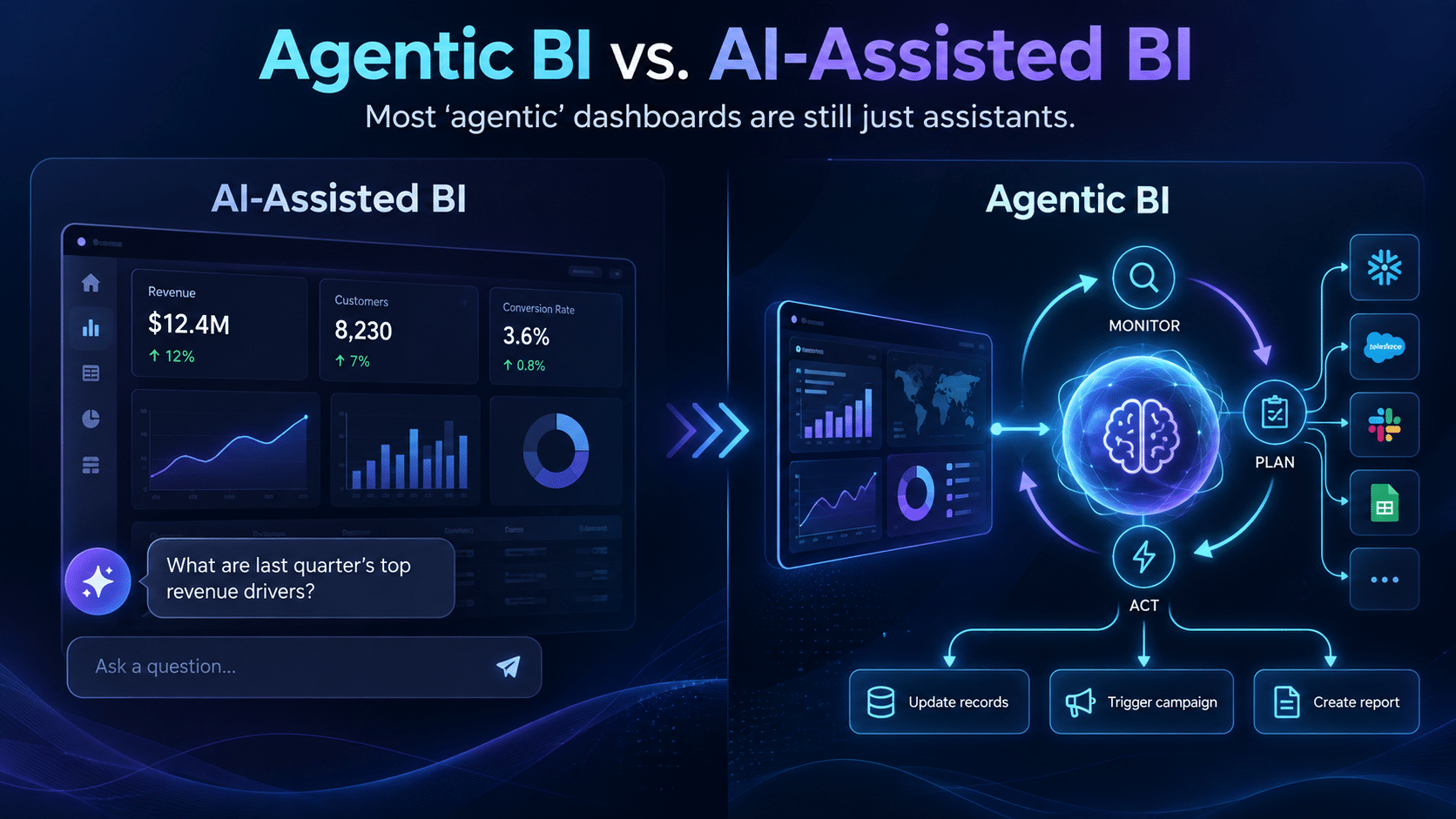
Open any BI vendor’s homepage right now and count how many times the word “agentic” shows up next to a screenshot of a chat box. It’s become the default label for anything that lets you type a question instead of clicking through a dashboard. The problem is that typing a question into a search bar and having an autonomous system investigate, decide, and act are two very different products, and the industry has spent the past year blurring the line between them on purpose.
Most of what gets marketed as “agentic” today is a natural language query layer wrapped around an existing dashboard. The user asks a question, the system converts it into SQL against the tool’s existing semantic model, and the output is a chart or a table, the same output a human analyst would have produced by clicking through filters.
Gartner’s own capability framework for this category, laid out in its Gartner Peer Insights market definition for agentic analytics, treats natural language query as just one of five must-have capabilities, alongside data source connectivity, data preparation, agent workflow orchestration, and automated insight generation. A tool that only offers the first one isn’t wrong to call itself AI-powered. It’s wrong to call itself agentic.
That distinction isn’t pedantic. A natural language interface still waits to be asked. It still hands the interpretation back to a human. It still lives inside the same dashboard-era product, just with a faster front door.
A Familiar Pattern
Treat this difference like the difference between a GPS and an autopilot. A GPS is remarkable, but it only speaks when you ask it: given where I’m currently, where I want to go, and what’s the route? You still have to see the traffic, decide on the en route, and steer the car. An autopilot does everything, from watching the road to actions before you’d have thought to ask. Most “agentic” BI tools on the market today are GPS units with a new paint job. A genuinely agentic system is closer to the autopilot: it’s still not driving the car alone, but it’s doing real work you didn’t have to request.
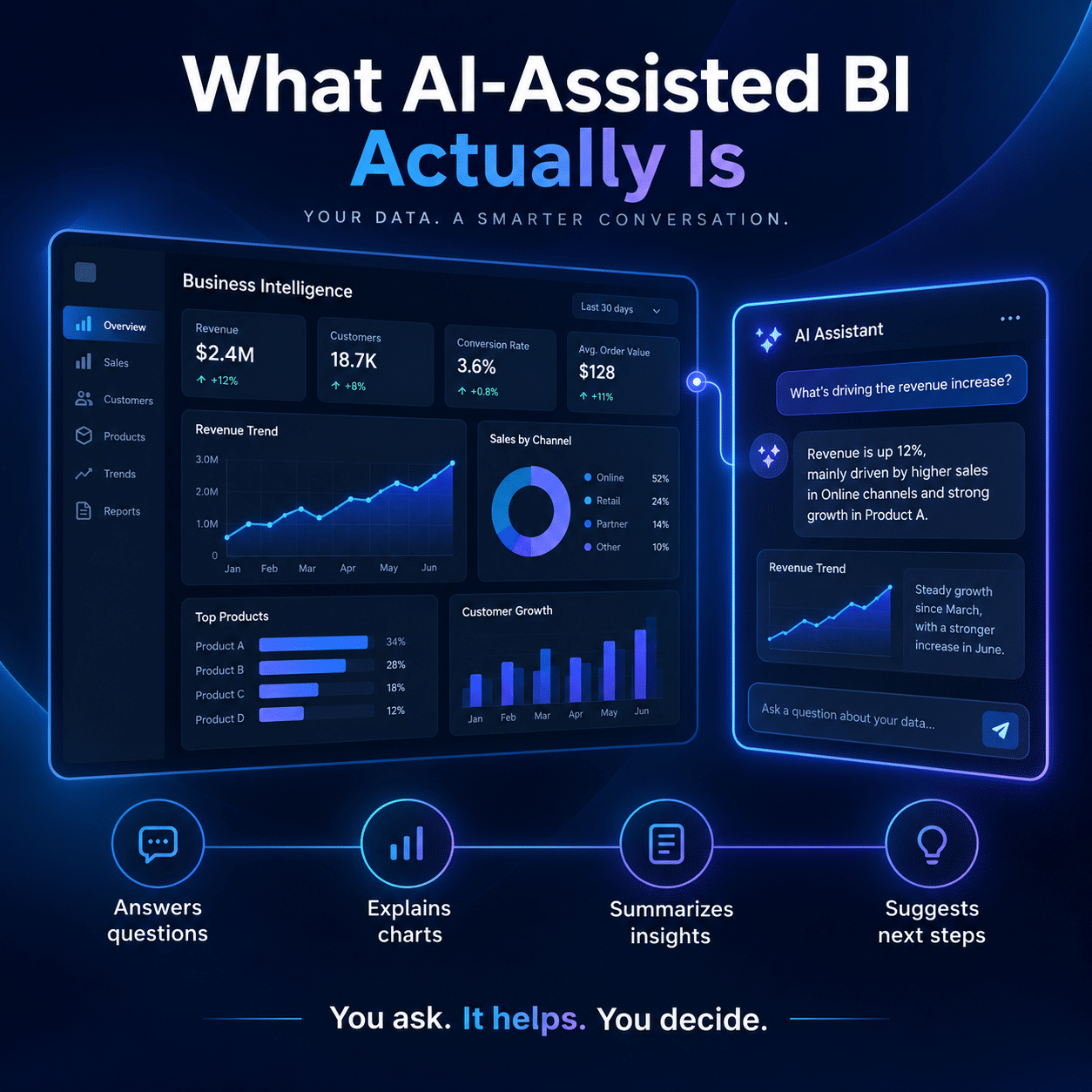
Gartner defines this agentic analytics as software that applies AI agents across the total data-to-insight workflow, demonstrating tasks semi-autonomously or autonomously toward a stated goal, not just answering a single question on demand. The system then decides what to queue in next, puts results together, and produces a final output, a dashboard, summary, or an alert, without a human directing each step. It’s the single difference between a tool that answers when asked and one that decides something is worth keeping on top of in the first place.
Very few products on the market clear all four bars today. Most clear the first one, sometimes the fourth, and market the result as if it cleared all of them.
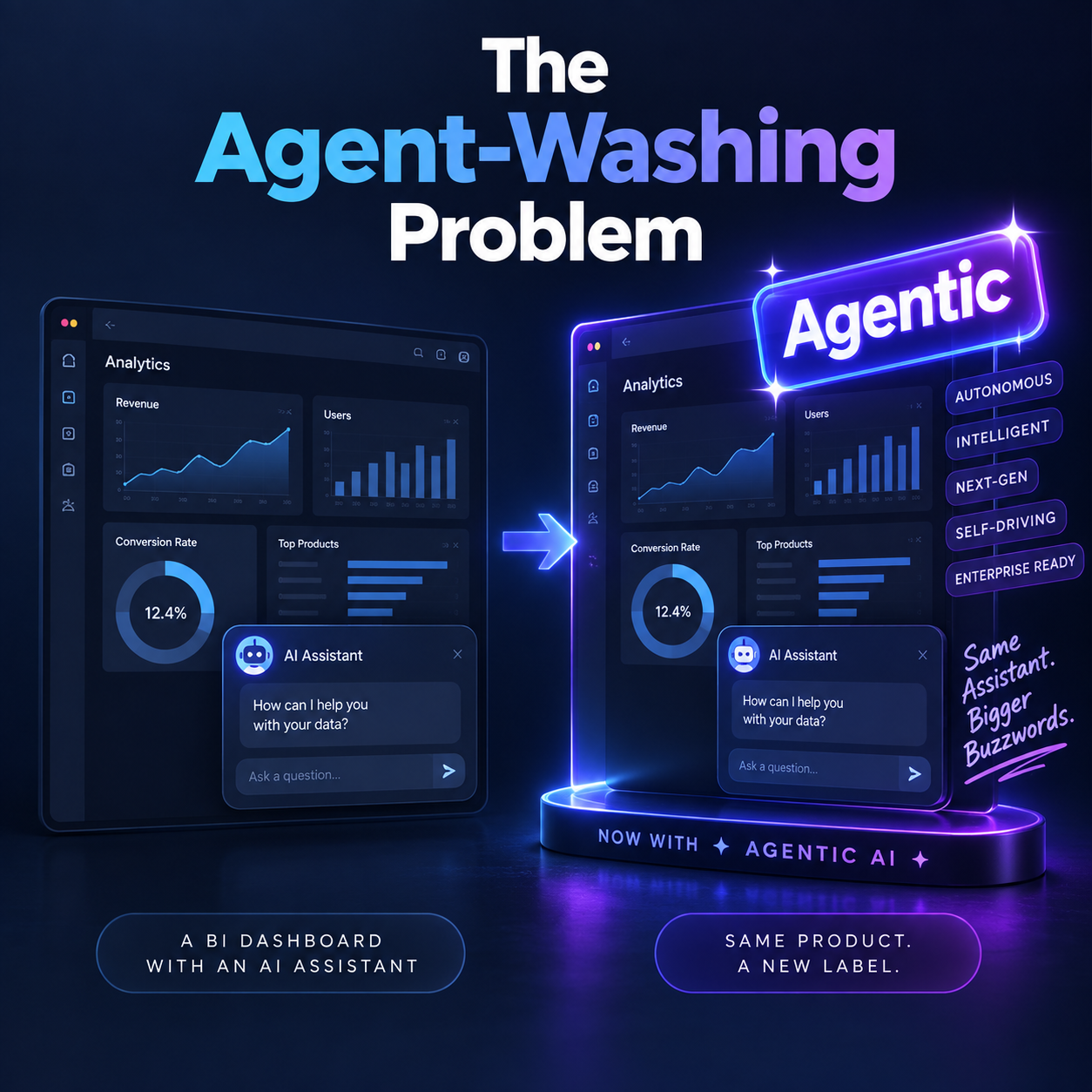
This isn’t a fringe complaint. Gartner has a name for exactly this pattern: agent washing, the rebranding of existing products, AI assistants, robotic process automation, and chatbots, without any substantial agentic capability behind the label. In a June 2025 Gartner press release, Senior Director Analyst Anushree Verma put a number on it: of the thousands of vendors marketing agentic products, Gartner estimates only around 130 are building something that genuinely deserves the label.
Enterprise buyers are catching on. Boston Consulting Group managing director Matt Kropp told CIO Dive that after a wave of generative AI hype, software companies needed something new to announce, so agentic features became the next headline, whether or not the underlying product actually changed. A separate CIO.com report on agent-washing found that even IT leaders can’t agree on where the line sits, since “agent” has become more of a marketing label than a well-defined technical term.
The capability that distinguishes the two categories isn’t the chat’s UI at all; it’s what sits underneath. Speaking at the Gartner Data & Analytics Summit in London, Distinguished VP Analyst Rita Sallam warned that without a clear, governed understanding of an organization’s data relationships, AI agents are far more likely to hallucinate, introduce bias, and produce results that nobody can trust. In a May 2026 Gartner press release, she put real numbers behind that warning: organizations that prioritize semantics in their AI-ready data can raise agentic AI accuracy by up to 80 percent and cut costs by up to 60 percent by 2027.
Gartner went further in its 2026 top predictions for data and analytics, calling a universal semantic layer a nonnegotiable foundation for any organization serious about AI-driven analytics, not a nice-to-have bolted on after the fact. That’s the real test for telling the two categories apart: a natural language box asking questions against raw or loosely governed data is AI-assisted BI, however slick the interface. A system reasoning through a consistent, governed semantic layer, deciding what matters and acting on it, is agentic BI.
If you’re evaluating a product that calls itself agentic, three questions cut through most of the marketing quickly:
A tool that fails all three isn’t lying about having AI. It’s just AI-assisted BI wearing a newer word.
Enterprise appetite for the real thing is genuine, but the gap between pilots and production is wide. McKinsey’s 2026 State of AI Global Survey found that 62 percent of organizations are at least experimenting with AI agents in some form, but only 23 percent have scaled an agentic system anywhere in the enterprise. Analytics and BI is one of the functions still waiting for that gap to close.
Independent BI research firm Dresner Advisory Services captured this shift directly inside its own annual research for the first time this year. Its 2026 Self-Service Business Intelligence Market Study now tracks natural language analytics and agentic AI alongside its established self-service metrics, noting renewed momentum in self-service BI that the firm expects to accelerate specifically as agentic capabilities mature, a sign that even independent analysts are treating today’s tools as a transition point rather than the finished product.
Gartner’s own agentic AI cancellation forecast is a useful gut check here too. The same June 2025 press release projected that more than 40% of agentic AI projects across all categories will be canceled by 2027 due to rising costs, unclear business value, or inadequate risk controls. It also forecasted that 33% of enterprise applications will have agentic AI by 2028, up from under 1 percent in 2024, and that roughly 15 percent of day-to-day work decisions will be made autonomously by that same year. None of the three cancellation causes Gartner names is a model-capability problem. All three are what happens when a team buys a rebranded chatbot expecting an autonomous analyst.
None of this means AI-assisted BI is worthless. A well-built natural language layer over a solid semantic model genuinely does reduce the time between a question and an answer, and for a huge share of day-to-day reporting, that’s exactly the improvement a team needs. The mistake is paying an agentic premium, in price, in trust, in workflow redesign, for a product that’s really just a faster way to ask a dashboard the same questions it always answered.
The organizations getting real value out of this shift aren’t the ones with the most polished chat interface. They’re the ones asking the three questions above before they sign anything, and building the semantic groundwork the analysts keep pointing to before they expect an agent to reason over it correctly.
