
Enterprises today are shifting the conversation about AI use cases. Instead of asking what can AI do, the question has become: is the investment worth the outcome?
We’ve seen plenty of headlines lately about companies overspending on AI initiatives and being forced to pare back their effort. Nearly 70% of organizations ran over budget in their AI deployments in 2025. For many, proving the value of AI investments is a struggle. Only 9% of companies surveyed reported that the majority of their AI projects delivered a measurable financial gain.
Capability questions dominated the last few years (which model, which vendor, which use case). But now that most organizations have run pilots and stood up dashboards, leadership wants to know if the AI analytics investment is paying off.
It’s a fair question, but most companies still evaluate AI investments intuitively, a sense that things are faster, or that a team seems more productive, rather than with the same financial discipline they’d apply to a new piece of equipment or a facility expansion. That gap between “it feels like it’s working” and “we can prove it’s working” is exactly where AI analytics budgets get questioned at renewal time.
Broad-purpose generative AI tools tend to produce diffuse gains that require real work to translate into dollars. Analytics AI is different. Predictive analytics, prescriptive analytics, anomaly detection, and correlation analytics are applied to targeted, well-defined use cases, which makes their financial impact more directly attributable, at least in theory.
The catch is that “more attributable in theory” doesn’t mean “already measured in practice.” Most organizations still lack a consistent way to actually track and prove the value their analytics investment is generating.
MIT Sloan Management Review researchers identified three approaches that map cleanly onto analytics investments specifically, and can serve as a rough maturity ladder for where your organization currently sits.
Start narrow. Pick one function, like risk management, sales forecasting, or supply chain, and deploy analytics there with tightly scoped, function-specific metrics, such as:
This approach is easiest to measure and defend, which makes it a strong starting point for building internal credibility. The tradeoff here, though, is that results from one function may not translate cleanly to another, and each team might define value differently.
As function-level wins accumulate, the next step is standardizing how you measure them:
This is the bridge between scattered proof points and something closer to a company-wide ROI picture.
At full maturity, analytics investments get evaluated the way any major capital investment would, analyzing:
Few companies operate here today, but it’s the optimal stage in measuring AI maturity ROI.
Most enterprises are somewhere between stage one and stage two. Knowing where you sit is a useful diagnostic before you try to fix your measurement approach.
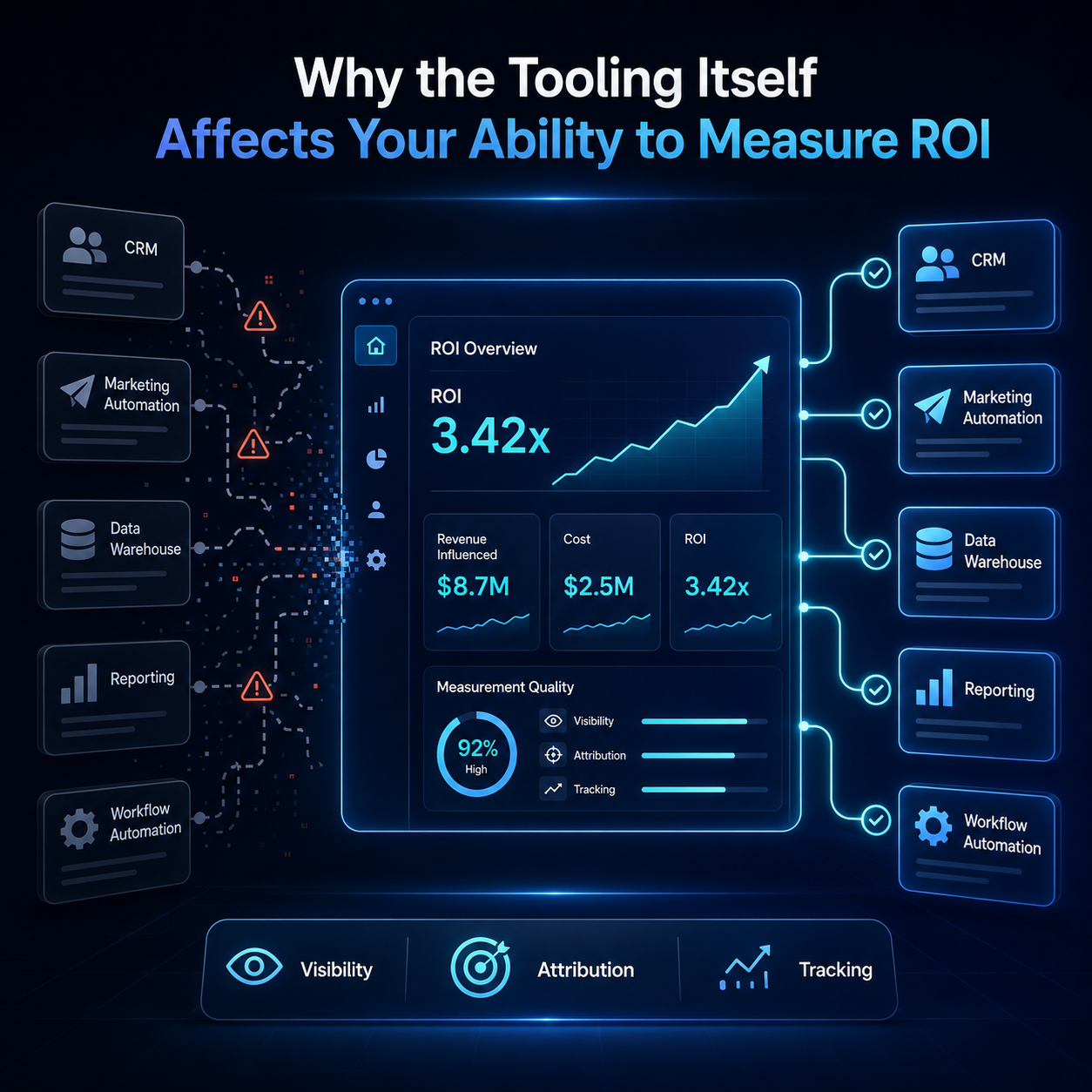
Here’s what the framework above doesn’t fully capture, however. Sometimes the attribution problem is more structural than about the metrics.
When data prep, business intelligence, predictive modeling, and risk analytics live in four different tools, every hand-off between them is a place where value can get diluted or lost. A forecasting improvement generated in your ML platform has to survive a hand-off to your BI tool before anyone sees it, and another hand-off to whatever system tracks the business outcome. By the time a result reaches a dashboard, it can be difficult to say with confidence which tool (or investment) actually produced it. That ambiguity is a major reason AI ROI still feels like a moving target to so many executives, even when the underlying use case is sound.
An end-to-end platform that handles data intake, insight generation, and advanced analysis within a single system removes most of those hand-offs. When you can draw a straight line from the raw data to a specific decision, it’s easier to trace a dollar of value back to the investment that created it. That’s less about any one feature and more about keeping the entire measurement chain intact.
When starting to work through your ROI analysis, start here:
AI analytics ROI isn’t unmeasurable. But it’s typically under-measured because the infrastructure supporting it wasn’t built with attribution in mind. Whether you’re just proving value in a single department or building toward enterprise-wide portfolio management, the goal is the same. You want a straight, traceable line from data to decision to dollar.
That’s the design principle behind IDA’s platform with data intake, insight, and analysis in one connected system, so measuring what your investment actually returns doesn’t require chasing numbers across different tools.
Want to see how IDA works? Request a demo, and we’ll walk through it with your team.
