

Every BI vendor on the market has slapped “agentic” onto their homepage in the last year. Dashboards that used to be “AI-powered” are now “agentic.” Chatbots that summarize a report are suddenly “autonomous analytics.” Ask five people at five different companies what agentic BI actually means, and you’ll get five different answers, most of which just describe a slightly smarter version of the tool they already had.
That gap is worth closing, because the technology underneath the label is real. It’s just gotten stretched to cover almost anything with a chat box attached to it. The confusion isn’t really about whether the term means something. It’s about how loosely “something” has been defined so far.
Agentic BI is analytics software that plans out a multi-step investigation and queries the data on its own, grounded in metric definitions the business has already agreed on, rather than handing back a single answer to a single question.
A handful of components have to be in place before a BI tool is doing something meaningfully different from a smarter search bar.
Instead of matching a question to a prebuilt report, the system breaks the question apart: what data is needed, in what order, and what has to be checked before an answer is safe to trust.
This is the part most vendor pitches skip past. A semantic layer is the shared definition of what “revenue” or “active customer” means across the company. MIT Sloan Management Review’s overview of agentic AI notes that the technology carries the same data quality and governance demands as any other AI system, and that risk only grows once a system starts acting on what it finds rather than just describing it.
If the first query doesn’t fully answer the question, the system checks itself and pulls more context, closer to how an analyst works through an ambiguous request than how a search bar returns a single result.
The more mature systems don’t stop at an explanation. They can flag an anomaly to the right person or trigger a downstream workflow once new data comes in.
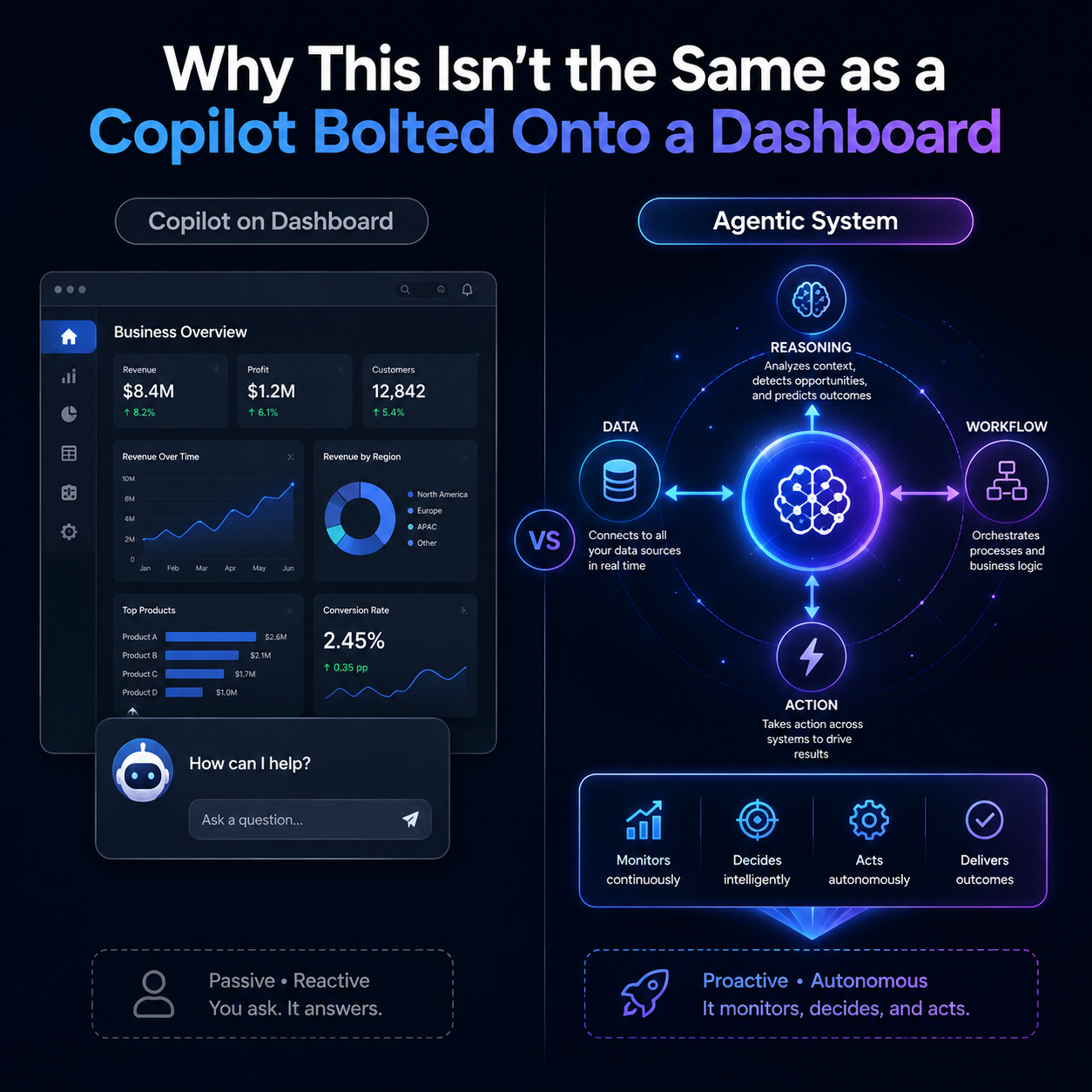
A lot of what gets marketed as agentic BI right now is really a copilot feature: a chat window sitting on top of an existing BI tool, still answering one question at a time, still limited to whatever report or table it was pointed at. That’s a real improvement over clicking through filters, but it’s not agentic in the sense that matters here.
A copilot waits for a prompt and returns a response. It doesn’t decide on its own that a metric needs re-checking, doesn’t chain several queries together to explain a pattern nobody asked about directly, and doesn’t act once it has an answer.
The practical test is whether the system can be handed a genuinely open-ended question and figure out, on its own, what needs to be checked to answer it properly, rather than routing the question to the single report that already covers something adjacent. A tool that can only answer questions the dashboard was already built to answer isn’t agentic. It’s just a faster way to read the dashboard.
Say a customer success lead asks: “Which accounts are showing early signs of churn risk, and why?”
A traditional dashboard shows a churn rate by segment, updated as of last month. The lead still has to dig through account histories one by one to figure out which ones are actually at risk right now.
A basic AI search layer might return a ranked list, pulled from whichever table it queried first, with no way to confirm whether that list matches how the retention team actually defines “at risk.”
An agentic BI system pulls up the actual governed definition of churn risk first, then works through usage data, support tickets, and renewal dates together. What comes back isn’t just a list; it’s the reasoning behind it: this account’s tickets spiked, that one’s usage has been sliding, another’s renewal is thirty days out with barely any recent activity. It’ll even catch the two accounts that tipped over the threshold just this week, before anyone on the team got around to checking.
➢ Product: A product manager can ask which features actually correlate with account expansion, and get an answer built straight from usage telemetry and billing history combined, rather than waiting on a data analyst to join the two datasets by hand.
➢ HR: A people analytics lead notices attrition ticking up on one team and wants to know why. Instead of pulling three reports, tenure data, engagement scores, manager changes, and trying to eyeball a pattern across them, the answer comes back already stitched together, with the actual cause named instead of implied
➢ Customer Success: Instead of a weekly health-score report, the system can surface accounts trending toward risk mid-cycle and explain what changed, before the quarterly check-in where it would otherwise get caught too late.
➢ IT: An infrastructure lead can ask what’s driving a cost spike in cloud spend and get a breakdown by service, team, and workload, with the system flagging which changes actually correlate with the increase instead of just correlating with the calendar.
None of the above holds up on messy data. A few things need to already be in place.
If finance and marketing calculate “revenue” differently, an agent has no way to settle that disagreement on its own. It simply queries whichever definition it happens to reach first, and hands back that number with total, unearned confidence. The inconsistency doesn’t get flagged or resolved. It just gets reflected back to whoever asked, faster than before.
An agent pulling from a partial data picture, one system that isn’t connected, a table that’s out of sync, a source it can’t reach, will still produce an answer. Nothing about the response signals that anything is missing. It just won’t be the right answer, and it will read exactly as confident as one that is.
If finance and marketing calculate “revenue” differently, an agent has no way to settle that disagreement on its own. It simply queries whichever definition it happens to reach first, and hands back that number with total, unearned confidence. The inconsistency doesn’t get flagged or resolved. It just gets reflected back to whoever asked, faster than before.
The system needs clear boundaries on what it can touch and when a person needs to sign off before it acts. That includes who can even ask certain questions in the first place, since a finance metric surfaced to the wrong audience without context can cause its own kind of damage.
If finance and marketing calculate “revenue” differently, an agent has no way to settle that disagreement on its own. It simply queries whichever definition it happens to reach first, and hands back that number with total, unearned confidence. The inconsistency doesn’t get flagged or resolved. It just gets reflected back to whoever asked, faster than before.
This is where agentic BI departs furthest from a chatbot: a wrong answer is embarrassing, but a system that updates a forecast or reroutes a report on bad data has consequences that don’t undo themselves.
If finance and marketing calculate “revenue” differently, an agent has no way to settle that disagreement on its own. It simply queries whichever definition it happens to reach first, and hands back that number with total, unearned confidence. The inconsistency doesn’t get flagged or resolved. It just gets reflected back to whoever asked, faster than before.
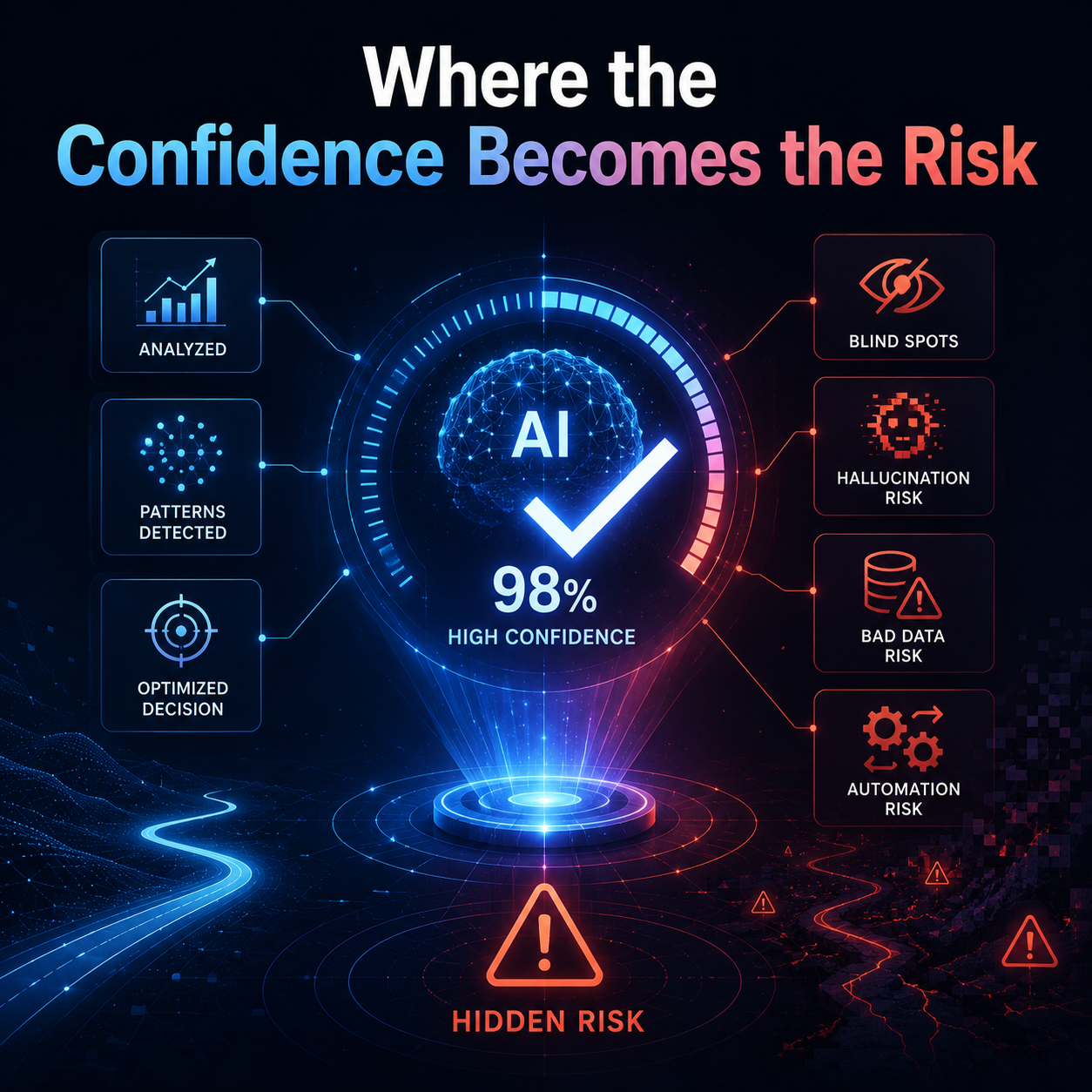
The failure mode nobody puts on the vendor slide isn’t that the system fails to answer. It’s that it answers fluently using a number nobody signed off on.
VentureBeat’s research into enterprise AI deployments found something telling: 57% of enterprises have already traced a confidently wrong agent answer back to their own missing or inconsistent business context, not the model itself. Gartner’s read on the broader agentic AI market lines up with that. The firm expects more than 40% of agentic AI projects to get canceled by the end of 2027, and the reasons it points to are unclear ROI and governance that never caught up, not the technology falling short.
That caution shows up in how much authority companies are actually willing to hand over. A Harvard Business Review Analytic Services survey, covered by Fortune, found that only 6% of companies fully trust AI agents to run core business processes without supervision. Most restrict them to routine or supervised tasks.
For BI specifically, that means the parts of the business most willing to hand real decisions to an agent right now tend to be the ones with the cleanest, most governed data underneath the question, not the ones with the flashiest natural language interface on top of it.
Strip out the marketing and agentic BI comes down to this: analytics that plans a multi-step investigation instead of returning a single query result, grounded in metric definitions the whole business has already agreed on, with enough autonomy to take the next step without someone opening a new report to ask for it.
The label caught on because the underlying shift is real. What separates the organizations getting value from it isn’t the chat window on top. It’s the less visible work underneath: one definition per metric, systems that actually connect, and clear rules for what the agent is allowed to do once it has an answer. The term is cheap to adopt. The foundation under it isn’t.
