
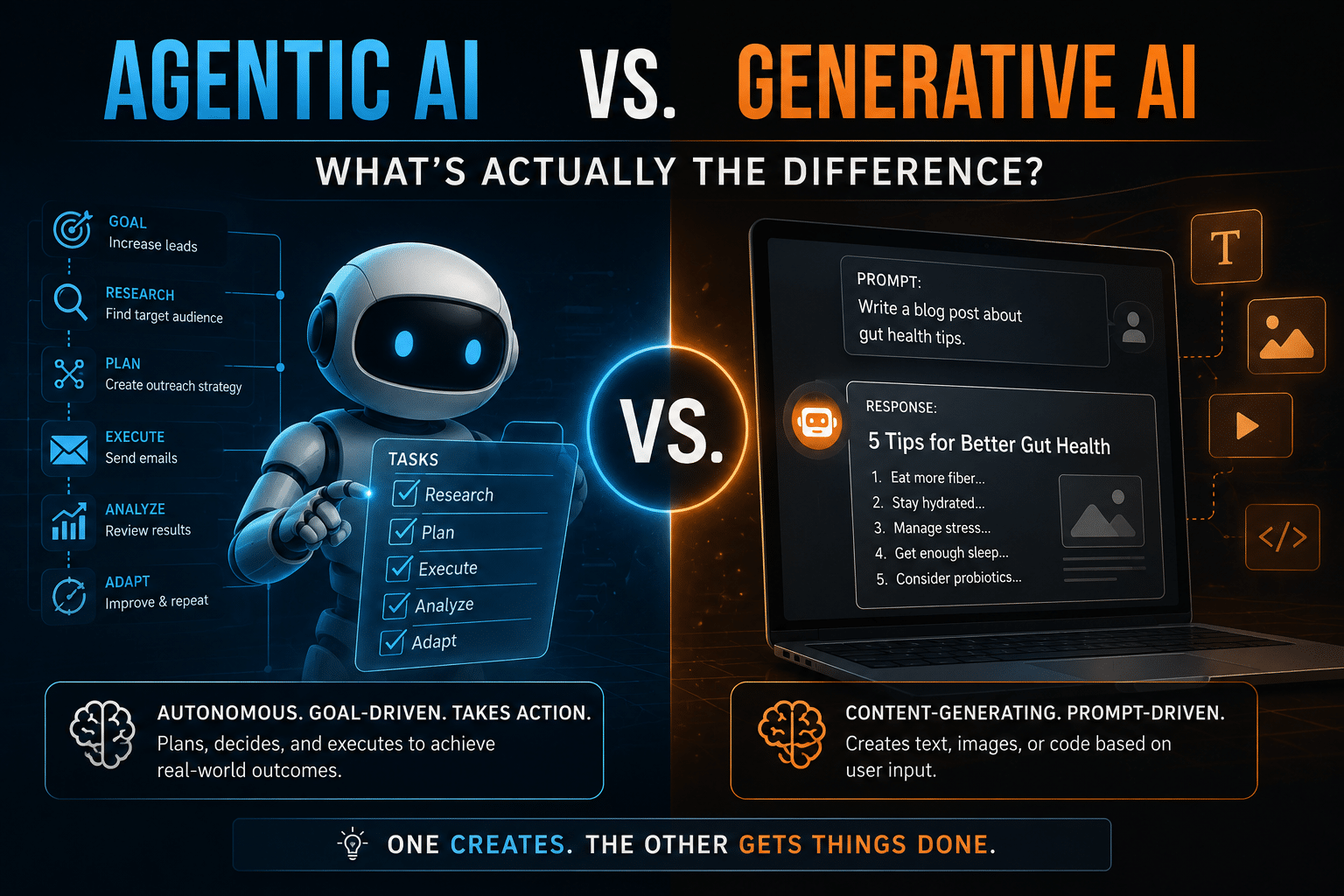
Generative AI creates things. Agentic AI does things. That one distinction unlocks nearly everything you need to see, but the details of how it plays out are where the majority of the people get lost.
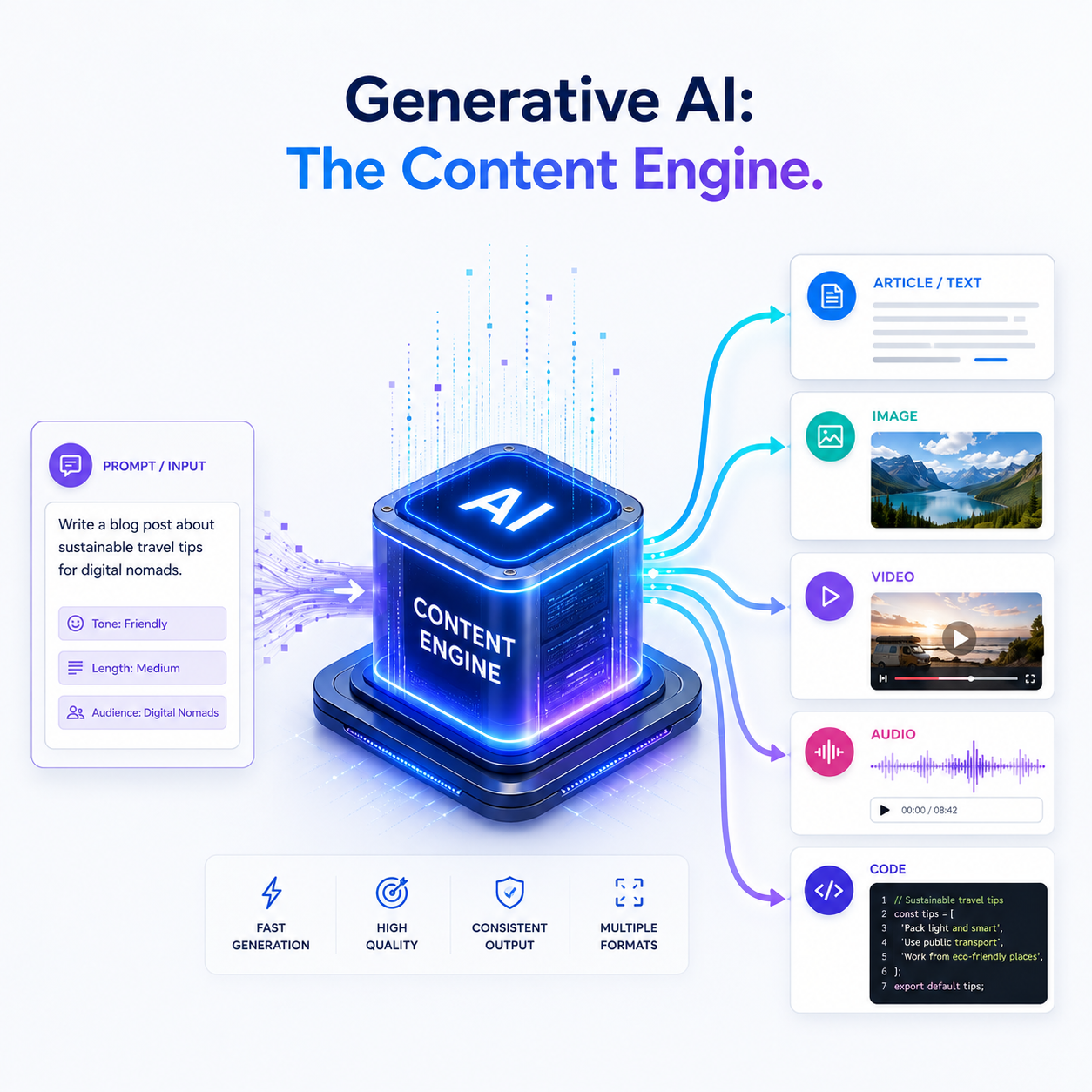
Generative AI is the AI you’ve already been using, probably every day, regardless of whether you call it that or not. It’s the model that takes the prompt and produces something new from it: an email draft, a product image, a chunk of code, a summary of a fifty-page report. It’s made to do this by studying enormous datasets and picking up on the patterns buried inside them, then using those patterns to make totally new output that resembles what it learned from.
Tools like ChatGPT, Gemini, and Midjourney are the poster children here, and for good reason. They’ve reshaped how people write, design, and code since the category exploded into public awareness a few years back. But there’s a ceiling built into how they work. A generative model responds to a prompt, hands back an output, and stops.
Agentic AI starts from a different premise entirely. Instead of questioning “what should I generate in response to this prompt,” it asks “what needs to happen to reach this goal, and what should I do next.” It pursues the objective, makes instant decisions, and executes multi-step tasks with less human intervention, going well beyond simply producing content on request.
Picture the difference in a real scenario. Ask a generative tool to write an apology email about a delayed shipment, and it’ll write you a solid apology email. Hand the same problem to an agentic system, and it works through the whole chain:
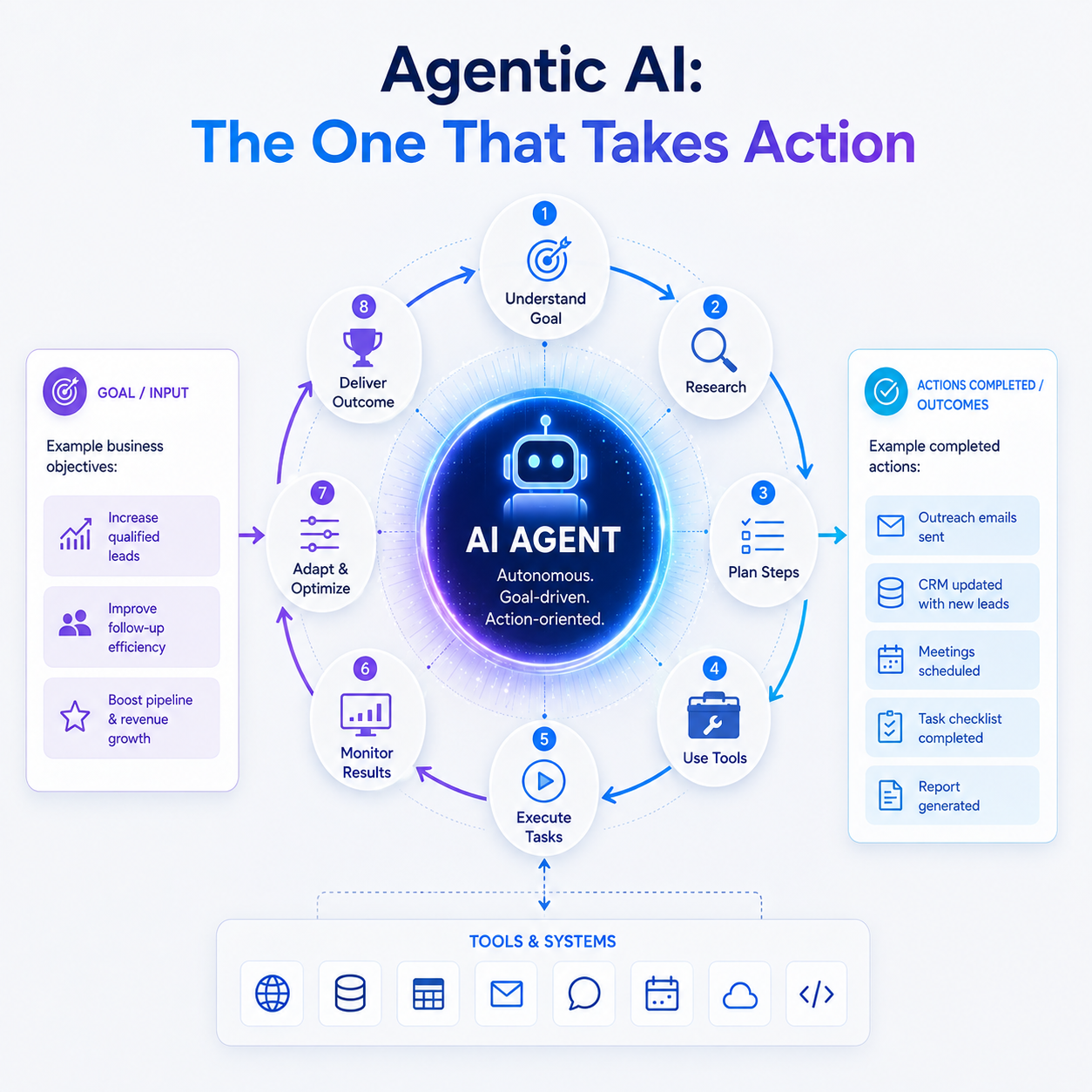
Agentic systems perceive their environment, reason through problems, break objectives into steps, interact with external tools like APIs and databases, execute actions, and learn from the results to improve next time.
It’s worth clearing up a common misconception here. “Agency” doesn’t mean the system has become conscious or independent-minded. It means it can act within a defined set of boundaries to reach a goal, not that it’s developed intentions of its own. It’s still a tool. It’s just a tool that can carry out a chain of steps instead of stopping after one.
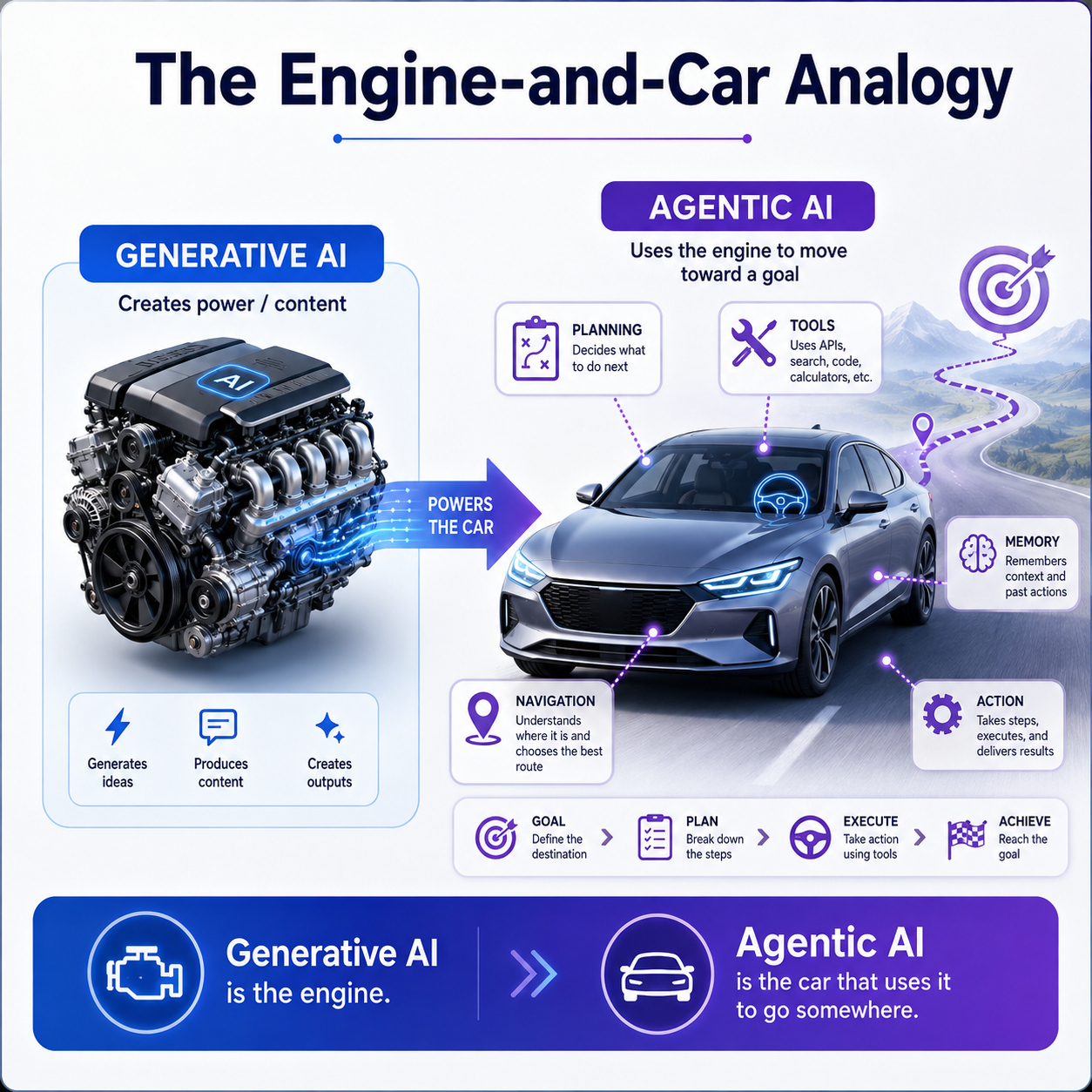
If you’re looking for a mental model that actually goes around, think about generative AI as the engine and agentic AI as the vehicle made around it. Agentic AI adds autonomy, planning, memory, and tool use on the top of a generative model, creating a system that can easily pursue goals all across multiple steps without needing human input.
The generative model is still doing a lot of work behind the scenes, especially the reasoning and language parts. But agentic AI wraps that engine in a framework that lets it plan a mission, react to obstacles, and actually drive somewhere, rather than just idling in place waiting for the next instruction.
This is also why the two aren’t really rivals. Almost every agentic system in production right now is built on top of a generative model acting as its reasoning core. You’re not choosing one over the other so much as choosing how much structure, autonomy, and tool access to wrap around the generative core you’re already using.
This distinction stops being academic pretty fast once you look at how businesses are actually deploying both.
It’s the same underlying model doing the language work in every case above. What’s different is everything wrapped around it.
Adoption data backs up how fast this shift is moving, even if it also shows the picture is messier than the hype suggests:
– 62% of organizations reported experimenting with AI agents as of 2025, according to McKinsey’s State of AI survey
– Only 23% had actually scaled an agentic system into production
– Gartner expects 40% of enterprise applications to include task-specific AI agents by the end of 2026, up from under 5% just a year earlier.
That gap between experimenting and scaling is the part most headlines skip past. It’s not that agentic AI doesn’t work. It’s that wiring an autonomous system into live business processes takes a lot more plumbing than pointing a chatbot at a customer inbox. Data has to be neat and clean, well connected across systems that were never made to talk to each other. Permissions have to be scoped correctly so an agent can’t accidentally touch something it shouldn’t. And someone internally has to actually trust the thing enough to let it run without a human checking every step, which turns out to be a bigger hurdle than the engineering itself.
Agentic AI carries a different kind of risk than generative AI, and it’s worth being blunt about it. Generative AI’s biggest liability is informational: a hallucinated fact or a biased output that a human catches before it goes anywhere. Agentic AI’s liability is operational. These systems are taking real actions on live systems, customer accounts, and business workflows, often with limited human oversight in the loop.
None of that means Agentic AI isn’t worth the investment. It means that the organizations ae getting real value out of it are the ones that are treating governance, oversight, and clear accountability as part of the deployment, not an afterthought bolted on once something breaks.
For day-to-day content work- drafting, summarizing, brainstorming- generative AI is still the right call, fast and flexible with a human in the loop on every output. Agentic AI earns its place once a task spans multiple steps and systems- the kind of coordination that would otherwise eat up hours of someone’s time, and you’re ready to invest in the oversight that comes with letting a system act on its own.
The confusion trending online isn’t really about definitions. It’s that the technology is moving faster than the terminology can keep up, and understanding the difference is quickly becoming the line between a tool that helps you write and a system that gets the whole job done.
